Baseline
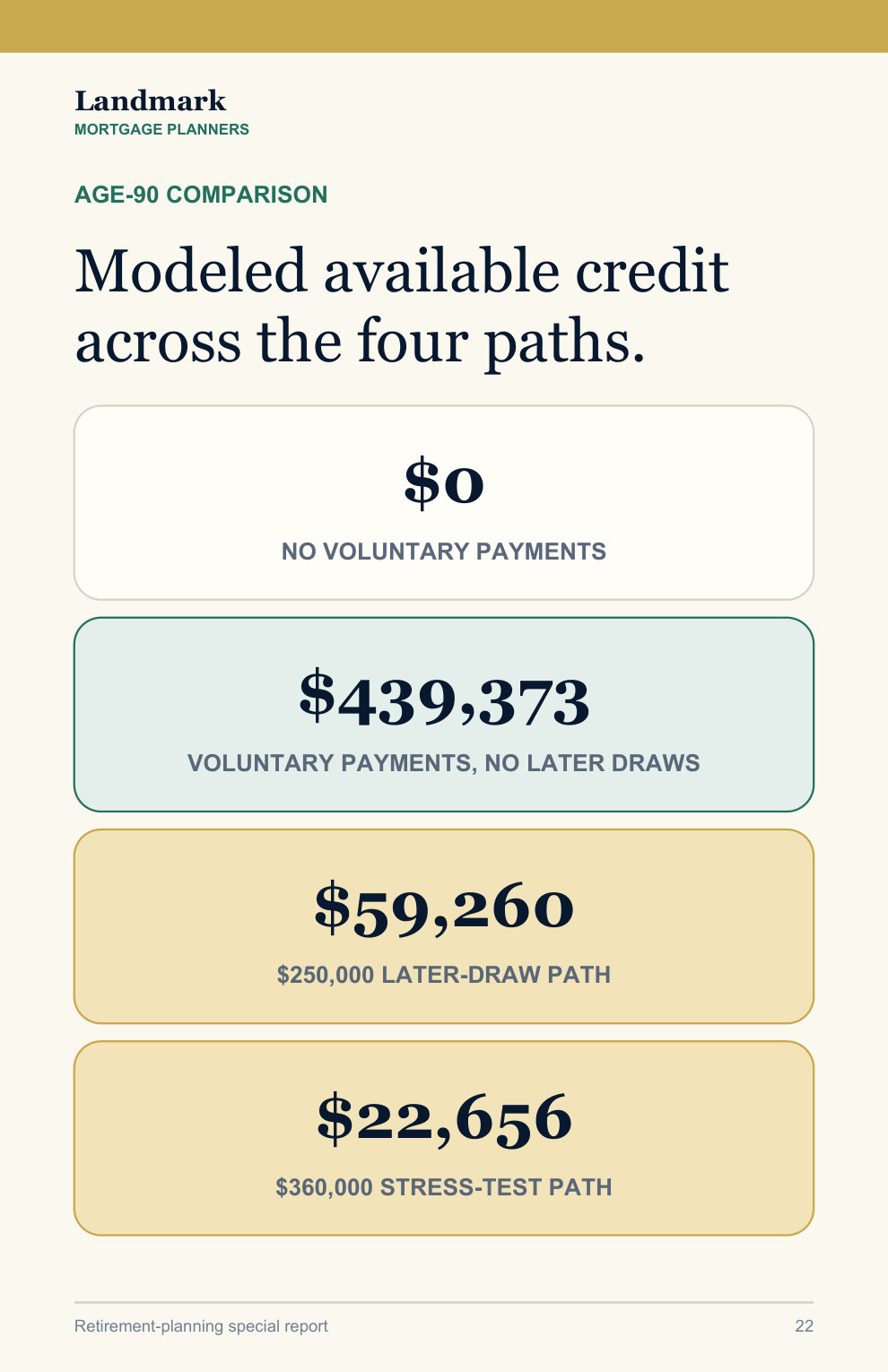
No voluntary payments; the loan balance accrues over time.

Free retirement guide + bonus illustrated case study
Retirement planning usually centers on investments, Social Security, taxes, and insurance. See why the home—and mortgage planning—belongs in that same conversation.
Inside: one 67-year-old homeowner, a modeled $220,000 purchase, and four separate paths showing what the financing decision could make possible now and later.
Send Me Both Free ResourcesFree retirement guide + bonus illustrated case study
See why the home belongs in the same retirement-planning conversation as investments, Social Security, taxes, and insurance. Then see why money kept available at closing may be only the beginning of the comparison.
Enter your full name and email and we'll send both resources to you.
Educational illustration only. A HECM is a loan with interest, costs, eligibility requirements, and continuing homeowner obligations.
Inside What If You Live?
The guide connects the big retirement question—how long your money may need to last—to the wealth already inside your home. Then it uses one homeowner's modeled figures to compare four different planning paths in plain English.
The missing conversation
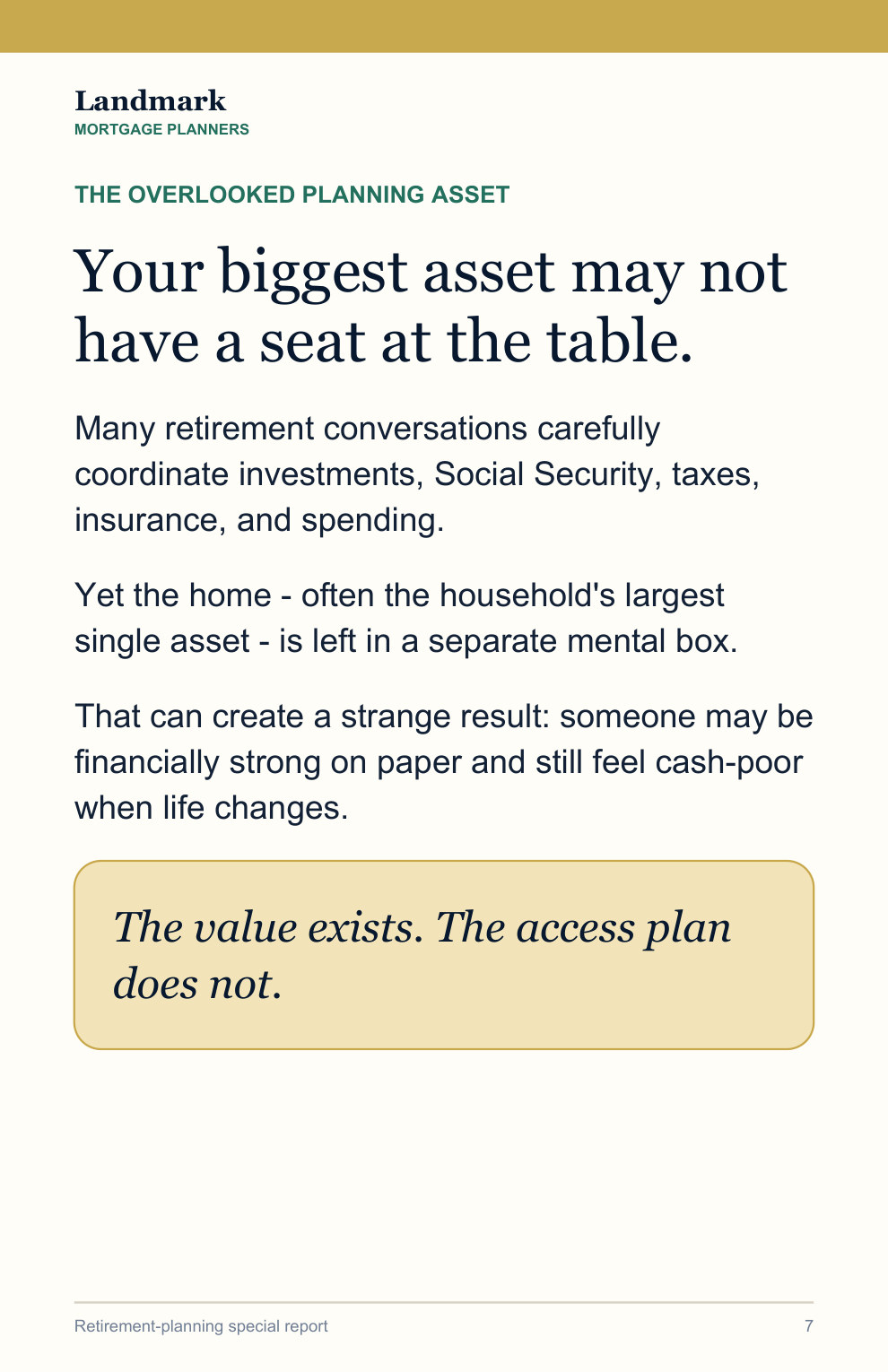
Many plans coordinate investments, Social Security, taxes, insurance, and spending while leaving the home—often the household's largest asset—in a separate mental box.
The report asks whether that asset should remain untouched or be planned alongside everything else. Sometimes the right answer is to do nothing. The point is to compare the choices before life makes the decision for you.
One homeowner. Four possible futures.
The modeled purchase left $73,116 available at closing instead of tying the full $220,000 up in the home. Four separate paths then show what the structure could make possible later—and what it could cost.
No voluntary payments; the loan balance accrues over time.
A modeled $1,000 monthly payment builds future borrowing capacity.
Ten modeled $25,000 annual loan advances beginning at age 80.
Three modeled $120,000 annual loan advances beginning at age 87.
Borrowing capacity is not savings-account cash
With an adjustable-rate HECM, unused availability can increase over time under the loan terms. The growth calculation uses the same rate components applied to the loan balance—but it increases future borrowing capacity, not cash in a savings account, investment earnings, or home-price appreciation.
Under current federal tax treatment, HECM advances are generally loan proceeds rather than taxable income. They are still borrowed funds, increase the loan balance, and should be reviewed with a qualified tax professional.
Worth exploring when
Pause and compare when
Get both free resources